The Woman Who Refused to Let Anyone Steal Her Idea
A factory worker. A self-taught inventor. A businesswoman. And the brilliant mind behind a machine that changed the way America carried its goods.
Imagine This:
You have spent years developing an idea.
You have studied the problem. Built prototypes. Created detailed drawings. Worked through failure after failure until your invention finally works.
Then someone else sees it.
And decides to take it.
That is exactly what happened to Margaret Knight.
But the person who tried to steal her invention made one very serious mistake:
He underestimated her.
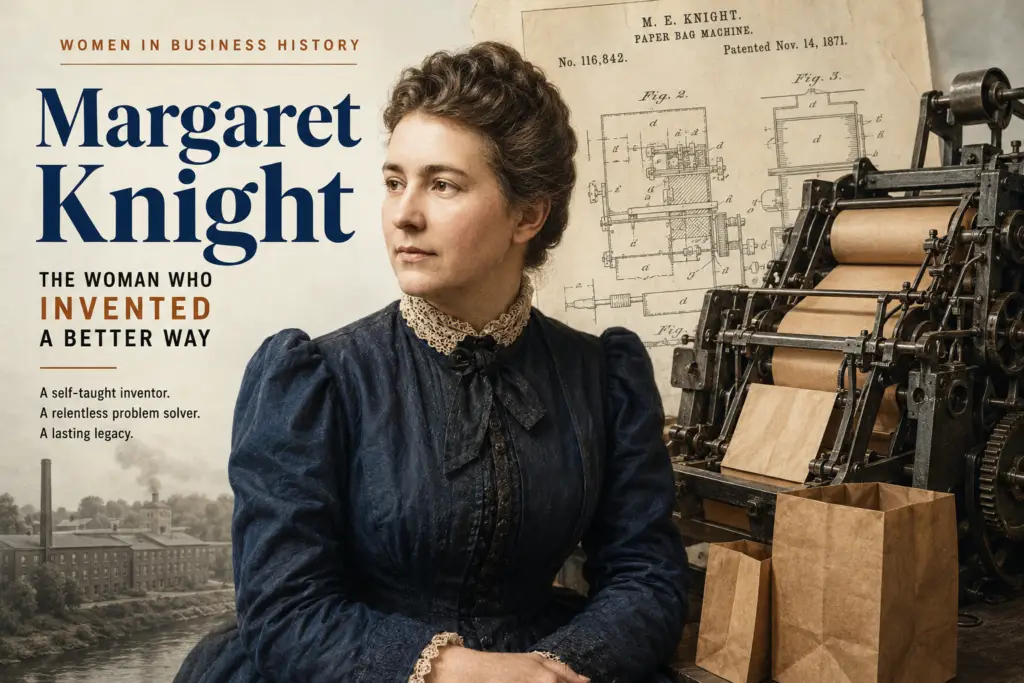
In the late 1800s, when women were routinely excluded from engineering, manufacturing and business opportunities, Knight designed a machine capable of automatically cutting, folding and gluing flat-bottom paper bags.
The invention would help transform paper bag manufacturing—and become part of the story behind one of the most familiar products in everyday life.
But before Margaret Knight could secure her patent, she had to fight to prove that the idea was actually hers.
Her story is one of innovation, persistence, intellectual property and entrepreneurial courage.
And more than 150 years later, her lessons are still remarkably relevant to today’s small business owners.
A Girl Who Preferred Making Things
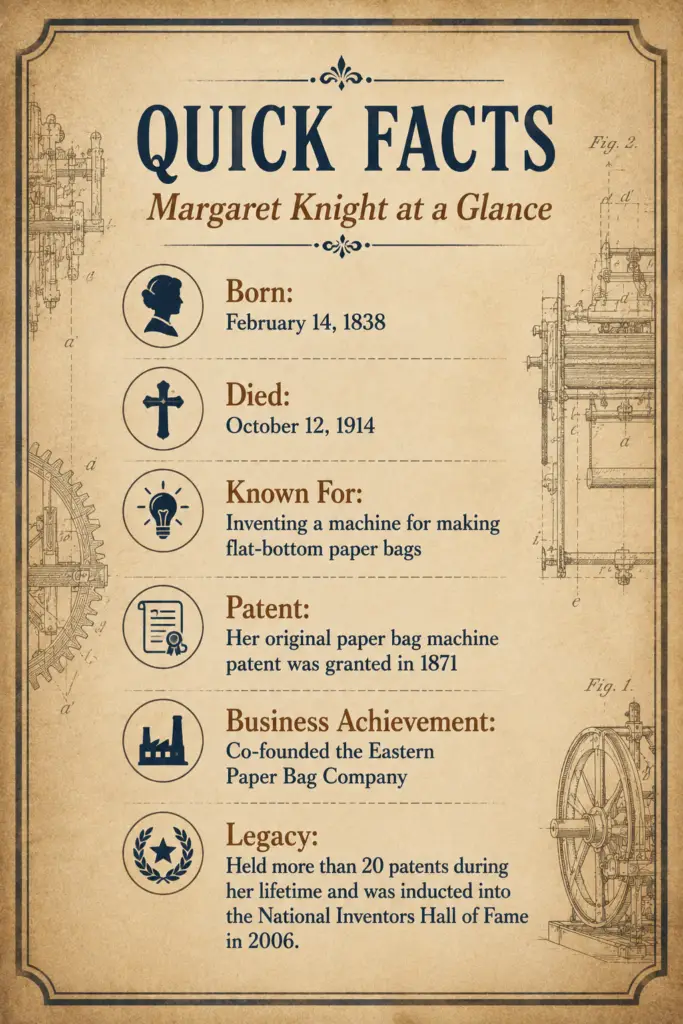
Margaret E. Knight was born in York, Maine, in 1838.
From an early age, she was fascinated by building and creating. She made toys, kites and sleds and showed a natural curiosity about how things worked.
Her childhood took a difficult turn when her father died. At age 12, Knight’s family moved to New Hampshire, where she began working in a textile mill to help support the household.
The mills were dangerous.
One day, Knight witnessed a worker seriously injured when a steel-tipped shuttle flew from a loom.
Most people might have seen the accident as simply another unfortunate part of factory life.
Knight saw a problem.
And she began thinking about a solution.
She developed a safety device designed to restrain the shuttle and help prevent similar injuries. The idea was adopted by mills, but because Knight was young and unfamiliar with the patent system, she received no compensation for her invention.
It was an early—and expensive—lesson.
A good idea has value. But protecting that idea matters, too.
The Everyday Problem That Changed Everything
Years later, Knight went to work at the Columbia Paper Bag Company in Springfield, Massachusetts.
At the time, paper bags were difficult and time-consuming to produce.
Many bags were folded by hand, and the familiar flat-bottom design was expensive to make manually.
Knight immediately recognized an opportunity.
What if the process could be automated?
She began experimenting.
Her solution was a machine capable of cutting, folding and gluing paper into a flat-bottom bag.
The result was a major improvement in both production speed and consistency. Instead of relying on labor-intensive hand assembly, manufacturers could produce practical flat-bottom bags on a much larger scale.
The invention helped make possible the widespread use of the paper bags that would become familiar in grocery stores, shops and lunchrooms.
“Great entrepreneurs often see what everyone else sees—then notice what could work better.”
Then Someone Tried to Take Credit
Knight understood something important from her earlier experience in the textile mills.
This time, she needed to protect her invention.
But while she was having a working metal model constructed, a machinist named Charles Annan attempted to claim the design as his own.
His argument was rooted in the prejudice of the era.
He claimed that a woman could not possibly understand the mechanical complexity required to design such a machine.
Margaret Knight did not quietly accept the accusation.
She fought back.
In court, Knight presented evidence of her work, including detailed drawings, notes and documentation of the invention’s development. She also demonstrated her deep understanding of how the machine worked.
The evidence was clear.
The invention belonged to Margaret Knight.
She won the legal battle and received her patent in 1871.
From Inventor to Businesswoman
Winning the patent was not the end of Knight’s journey.
It was the beginning of her next chapter.
Knight paired her technical skills with business ambition, co-founding the Eastern Paper Bag Company in Hartford, Connecticut. She also benefited financially through arrangements connected to her invention, eventually gaining the freedom to pursue invention as a full-time career.
Over the course of her life, Knight continued developing practical solutions across multiple industries.
Her inventions included improvements involving:
- Paper bag manufacturing
- Shoe manufacturing
- Engines and mechanical systems
- Window frames
- Other everyday industrial and household technologies
By the end of her life, Knight had accumulated more than 20 patents and had become one of the most prolific female inventors of her era.
5 Small Business Lessons from Margaret Knight
1. Problems Are Opportunities in Disguise
Knight didn’t start with a mission to become famous.
She paid attention.
A dangerous machine needed to be safer.
A manufacturing process needed to be faster.
A product needed to work better.
The same mindset drives successful businesses today.
Look closely at everyday frustrations. Someone’s inconvenience may be your next business opportunity.
2. Protect Your Intellectual Property
Knight learned this lesson the hard way.
Her first safety invention brought her recognition—but no financial compensation because she had not protected her rights.
Later, when someone attempted to steal her paper bag machine, she was prepared to defend her work.
For today’s entrepreneurs, intellectual property may include:
- Patents
- Trademarks
- Copyrights
- Trade secrets
- Contracts and licensing agreements
Innovation creates value. Protection helps preserve it.
3. Documentation Can Protect Your Business
Knight’s detailed records helped her prove ownership of her invention.
For modern entrepreneurs, documentation remains just as important.
Keep records of:
- Product development
- Original designs
- Business processes
- Contracts
- Communications
- Creative work
- Dates and versions of important projects
When questions arise about ownership, agreements or originality, documentation can make all the difference.
4. Expertise Doesn’t Always Come with a Traditional Title
Margaret Knight was largely self-taught.
She did not need an engineering degree to understand machinery.
She learned by observing, working, experimenting and building.
Today’s entrepreneurs should remember that valuable expertise can come from:
Experience. Curiosity. Practice. Failure. Observation.
Formal education can be valuable—but so can hands-on learning.
5. Don’t Let Other People Define Your Capabilities
Perhaps Margaret Knight’s most powerful business lesson is also the simplest.
Someone looked at her invention and essentially said:
“A woman couldn’t have done this.”
Her response was not to argue endlessly.
She brought the evidence.
She understood the machine.
She had the drawings.
She had done the work.
And she won.
WHY HER STORY STILL MATTERS
Margaret Knight’s name is not as widely recognized as many famous inventors from the 19th century.
But her impact is undeniable.
Her paper bag machine helped modernize manufacturing and contributed to the mass production of a product that became part of everyday commerce.
Her patent battle became an important example of a woman defending her intellectual property at a time when women faced enormous barriers in business and industry.
And her career demonstrated something that still matters today:
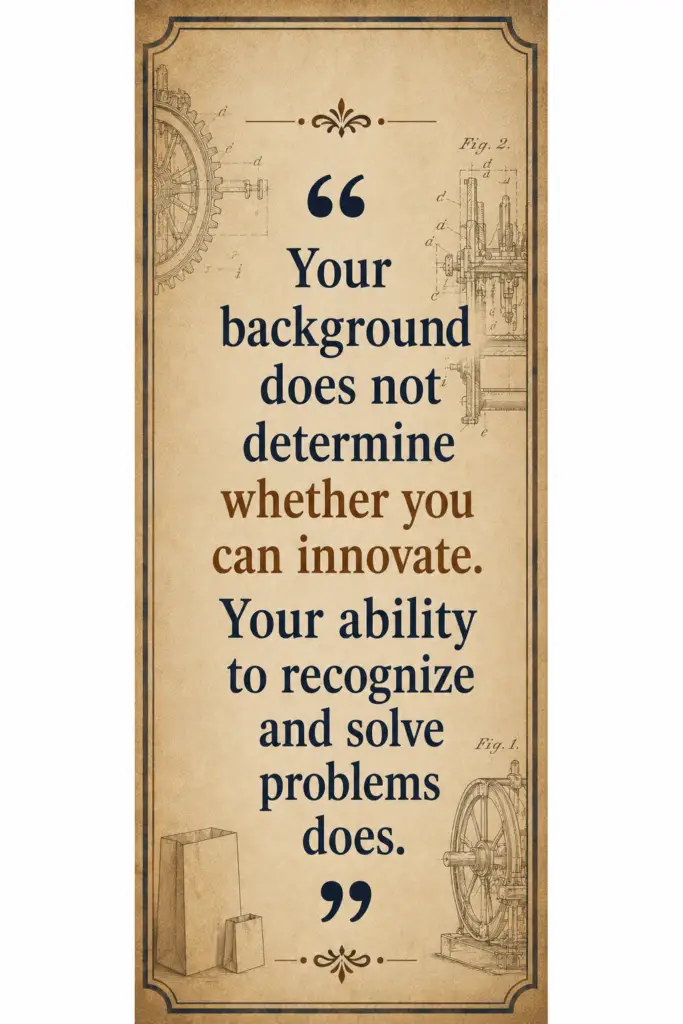
Innovation does not belong to one gender, profession, educational background or economic class.
Great ideas can come from factory floors.
From small businesses.
From employees.
From customers.
From people who simply refuse to accept that something must be done the way it has always been done.
Knight’s 1879 patent model for an improved paper bag machine is preserved in the Smithsonian’s National Museum of American History—a lasting reminder of the inventor behind an everyday object.
WOMEN IN BUSINESS HISTORY
Margaret Knight’s Legacy
The Problem She Saw:
Paper bags were inefficient and expensive to make by hand.
The Solution She Created:
A machine that automated the cutting, folding and gluing of flat-bottom paper bags.
The Challenge She Faced:
A man attempted to claim her invention and argued that a woman could not have designed such a complex machine.
The Action She Took:
She fought for her intellectual property and proved the invention was hers.
The Business She Built:
She went on to co-found the Eastern Paper Bag Company.
The Legacy She Left:
A lifetime of innovation, more than 20 patents, and an enduring example for women entrepreneurs and inventors.
THE BOTTOM LINE
Margaret Knight didn’t set out to become a symbol.
She set out to solve problems.
But in doing so, she became something more.
She became proof that innovation can come from anywhere.
That expertise can be earned through experience.
That an idea is worth defending.
And that sometimes the people who change an industry are the people willing to ask one powerful question:
“Why are we doing it this way—and how can we make it better?”
Small Business Showcase Takeaway
Margaret Knight reminds today’s entrepreneurs that innovation begins with curiosity—but success often requires persistence, protection and the courage to stand behind your own ideas.
She didn’t just invent a machine. She built a legacy.