
Celebrating the small business and entrepreneurial spirit! Join us in promoting your brand!

Celebrating the small business and entrepreneurial spirit! Join us in promoting your brand!


Why working harder isn’t always the answer—and how to build a business that works for you instead of the other way around

Busy Isn't the Same as Profitable

Let’s talk about something I think just about every small business owner can relate to: being so busy you barely have time to think, yet still wondering if you’re actually getting ahead.

You wake up with the best intentions. You’ve got your coffee, your to-do list, and a plan to finally get caught up. Maybe today is the day you’re going to tackle that marketing project, update your website, follow up with those potential clients, or finally organize your bookkeeping.

Then reality hits.

The phone rings. An email comes in marked URGENT. A customer needs something changed. Someone has a question that apparently only you can answer. Before you know it, half your day is gone, your coffee is cold, and that to-do list hasn’t gotten any shorter.

Sound familiar?

Trust me, I get it.

As a graphic designer with more than 30 years of experience, an independent business owner, and the founder and editor of Small Business Showcase Digital Magazine, I’ve worn more hats than I can count. Between client projects, designing ads, managing magazine content, marketing, networking, answering emails, and trying to grow a business, there are days when I feel like I need three more hours just to get through my morning.

And let’s be honest, sometimes being busy feels good. It makes us feel productive, needed, and like we’re accomplishing something.

But here’s something I’ve learned along the way: Just because your calendar is full doesn’t mean your bank account is.

There’s a big difference between being busy and being profitable. And if we’re not careful, we can spend so much time working in our businesses that we forget to work on them.

The Never-Ending To-Do List Trap

When you own a small business, there’s rarely anyone standing behind you saying, “Hey, that’s not your job. Let someone else handle it.”

You’re the salesperson, customer service department, bookkeeper, marketing director, problem solver, creative department, and sometimes the person who takes out the trash.

When I started M&D Advertising, I was responsible for just about everything. That’s part of being an independent business owner. You do what needs to be done because, well, there’s nobody else to do it!

 

But over time, those responsibilities can pile up until you’re spending more time managing the business than actually doing the work that brings in revenue.

Think about your typical day. How much time do you spend answering emails, scheduling appointments, making small revisions, organizing files, scrolling through social media, or putting out fires?

Now, how much time do you spend actually bringing in new business, building relationships, or working on projects that pay you?

Those answers might surprise you.

I’ve had days when I spent hours working on things that absolutely needed to get done, but none of them actually moved me closer to my bigger business goals. At the end of the day, I was exhausted, but I couldn’t point to one meaningful step toward growing the business.

Being busy can become a comfortable distraction from doing the things that actually grow your business.

And sometimes, the hardest part is recognizing that we’re the ones keeping ourselves stuck in that cycle.
Five Ways to Work Smarter, Not Harder

1. Figure Out What’s Actually Making You Money

Here’s a question: Do you know which of your products or services are the most profitable?

Notice I didn’t ask which ones bring in the most revenue.

There’s a difference.


For example, let’s say you’re a graphic designer. You have one client who pays you $500 for a project that takes you five hours. Another client pays you $300 for a project that takes you 15 hours, involves endless revisions, and requires approximately 47 emails back and forth.

Which client is actually more profitable for your time?

It’s easy to look at the $300 and think it’s good money. But when you factor in your time, expenses, and the number of revisions, that project might be costing you more than you realize.

I’ve had to look at my own services and think about how much time certain projects actually take. Designing an ad, updating a website, creating a marketing campaign, or making what seems like a simple revision can involve much more work than the client sees.

And that’s okay, as long as you’re charging appropriately for it.

Take a look at your services, products, and customers. Figure out which ones provide the best return for your time and effort.

Ask yourself:

  • Which services bring in the most profit?
  • Which customers are enjoyable to work with and pay on time?
  • Which projects seem to take forever?
  • Am I charging enough for the experience, knowledge, and time I’m providing?

You might discover that it’s time to raise your prices, change how you package your services, or stop offering something that simply isn’t worth the effort.

Your goal isn’t to work for every dollar you can earn. It’s to make sure the dollars you’re earning are worth the work you’re putting in.

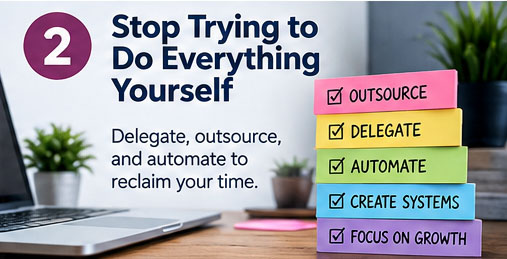
2. You Don’t Have to Be the Entire Staff

Raise your hand if you’ve ever said, “It’s just easier to do it myself.”

Yep. I thought so!

Entrepreneurs are often perfectionists. We know how we want things done, and explaining it to someone else can sometimes feel like more work than just doing it ourselves.

But here’s the problem: If you’re the only person who can do everything, your business can only grow as much as your personal time allows.

Imagine what you could accomplish if you weren’t responsible for every little detail.

Maybe you could outsource bookkeeping, hire someone to manage social media, automate appointment reminders, or have a virtual assistant handle routine emails.

Even if hiring isn’t in your budget right now, there are plenty of tools that can take some of the repetitive work off your plate.

For example, using a CRM to organize leads, schedule follow-ups, and automate emails can save you from constantly trying to remember who you need to contact next.

I know how easy it is to get caught up in the day-to-day details of running a business. But every hour spent on a task someone else could handle is an hour you’re not spending on something that requires your particular skills.

Start small. Pick one task you dread doing, one that eats up too much time, or one that doesn’t really need your personal attention.

Find a way to delegate, automate, or simplify it.

You don’t have to build a huge team to get some of your time back.

Remember, being a business owner doesn’t mean you have to do everything yourself. It means learning which things only you should be doing.

3. Learn to Say No Without Feeling Guilty

Oh, this one can be tough!

When you’re building a business, every potential client, project, referral, or partnership can feel like an opportunity you simply can’t afford to turn down.

Especially when you’re trying to grow your revenue, saying no can feel downright uncomfortable.

But not every opportunity is a good opportunity.

We’ve all encountered that customer who wants just one more little change, one more favor, one more phone call, or just a little something extra that wasn’t included in the original agreement.

And sometimes, in an effort to keep customers happy, we agree to things that end up costing us time and money.

I’ve learned that having clear expectations, written agreements, and boundaries is important. Your customers deserve great service, but you also deserve to be compensated fairly for your work.

Before accepting your next project, consider a few things:

  • Does this project fit my expertise and business goals?
  • Is the budget reasonable for the time and resources involved?
  • Will this customer respect my time and professional boundaries?
  • Is this the kind of work I want more of?

You don’t have to accept every project just because someone is willing to pay you.

Sometimes, saying no to a project that isn’t a good fit leaves room for a customer who values your work, respects your expertise, and is willing to pay what it’s worth.

And here’s another thing: You can say no politely and professionally without burning bridges.

A simple, “Thank you for thinking of me. Unfortunately, I don’t have the availability to take this on right now,” is perfectly acceptable.

Your time is valuable. Stop treating it like an unlimited resource.

4. Stop Treating Marketing Like Something You’ll Get to Eventually

If I had a dollar for every time a business owner told me they were too busy to market their business, I’d probably have enough money to take a very nice vacation!

And I understand why it happens.

When you’re busy serving customers, fulfilling orders, managing employees, and keeping up with daily operations, marketing can feel like one more thing on an already overflowing plate.

But here’s the catch: When you stop marketing, you can create a gap in your future sales pipeline.

You might be busy today because of the customers you attracted last month. But what happens next month if you haven’t done anything to attract new ones?

I’ve seen how important consistent visibility is for small businesses. Through M&D Advertising and Small Business Showcase Digital Magazine, I work with businesses that have wonderful products, great services, and amazing stories to tell. Yet many of them struggle with getting their names in front of the people who need what they offer.

Marketing isn’t just about creating a pretty graphic or posting something on Facebook when you remember.

It’s about building relationships, establishing credibility, and staying visible to the people who may eventually become your customers.

And no, you don’t need to spend thousands of dollars every month to do it.

Start with a few simple habits:

  • Post valuable content consistently on the platforms your customers actually use.
  • Send a monthly email newsletter to stay connected with existing customers.
  • Attend local networking events and build genuine relationships.
  • Ask satisfied customers for testimonials and referrals.
  • Partner with complementary businesses to reach new audiences.
  • Track where your leads come from so you know what’s working.

One of the biggest mistakes I see is business owners spending money on marketing without having any idea whether it’s producing results.

You don’t have to do every type of marketing. You just need to find the methods that connect you with your ideal customers and make a habit of using them.

Marketing shouldn’t be something you do only when business slows down. It should be part of how you keep business moving forward.

5. Make Time to Work on Your Business, Not Just in It

This might be one of the most important things you can do as a small business owner.

When you’re busy every day handling customers, projects, invoices, emails, and unexpected problems, it’s easy to lose sight of the bigger picture.

You’re so focused on keeping everything running that you don’t have time to ask whether you’re even running things the way you should.

I know how quickly a day can disappear when you’re juggling client work, magazine deadlines, marketing, and all the other responsibilities that come with running a business.

That’s why I think every business owner should schedule time to step away from the daily grind and look at the business as a whole.

Even one uninterrupted hour a week can make a difference.

Grab your coffee, close your email, silence your phone, and spend some time thinking about where your business is headed.

Ask yourself:

  • What did I accomplish this week that actually moved my business forward?
  • What tasks took more time than they should have?
  • Where am I losing money or missing opportunities?
  • What keeps causing the same problems over and over?
  • What is one thing I can change next week to make life easier?

Maybe you’ll realize that you’re spending too much time on a service that isn’t profitable. Maybe you need to update your pricing, improve your website, or finally set up an automated follow-up system.

Or perhaps you’ll discover that you need to stop taking on so much work and give yourself a little breathing room.

The point is to make intentional decisions instead of constantly reacting to whatever lands on your desk.

You can’t build a better business if you never take the time to look at how your current business is operating.

Let’s Talk About the Numbers (Yes, Even If You Hate Accounting!)

I know. Numbers aren’t everyone’s favorite subject.

As creative people, some of us would much rather be designing, creating, building, or talking to customers than staring at spreadsheets.

But you don’t have to be an accountant to understand the financial health of your business.

In fact, knowing a handful of key numbers can help you make better decisions and avoid some very unpleasant surprises.


Here are five things you should be keeping an eye on:

Revenue: How much money is your business bringing in? Look at your monthly revenue and compare it with previous months to identify trends.

Expenses: How much does it actually cost to run your business? Don’t forget subscriptions, software, supplies, insurance, marketing, and all those little expenses that seem insignificant until you add them up.

Profit: After paying your expenses, how much money is left? Remember, revenue isn’t the same as the money you actually get to keep.

Cash Flow: Do you have enough money coming in to cover your upcoming expenses? A profitable business can still run into trouble if customers aren’t paying on time or expenses come due before revenue arrives.

Customer Acquisition: How much does it cost you to attract a new customer? If you’re spending a lot of money on advertising or marketing, it’s important to understand whether that investment is generating enough business to justify the expense.

You can track these numbers using a simple spreadsheet, accounting software, or help from a bookkeeper.

The important thing is to review them regularly instead of waiting until tax season to figure out where your money went.

Your numbers tell a story. Make sure you’re taking the time to read it.

Sometimes, the Smallest Changes Make the Biggest Difference

When we think about growing a business, we often imagine big changes.

Hiring a team. Opening another location. Investing in expensive equipment. Launching a brand-new product. Spending thousands on a marketing campaign.

But growth doesn’t always have to be that complicated or expensive.

Sometimes, it’s the little things that make the biggest difference.

 

Imagine what could happen if you:

  • Increased your prices by a small amount to better reflect the value of your work.
  • Eliminated a software subscription you haven’t used in six months.
  • Created an email template for questions you answer every day.
  • Followed up with five potential customers every Monday.
  • Set up automatic appointment reminders to reduce missed appointments.
  • Created a process for requesting customer reviews.
  • Stopped offering a service that takes too much time for too little return.

None of these changes requires a major investment. But over time, they can improve your efficiency, strengthen customer relationships, and help you keep more of the money you earn.

The trick is to stop trying to fix everything at once.

Choose one area of your business that needs improvement. Focus on it for 30 days, measure the results, and decide what to do next.

You might be surprised at how much progress you can make by taking small, consistent steps.

Don’t Forget Why You Started Your Business in the First Place

Here’s something I think we don’t talk about enough.

Most people don’t start a business because they dream of spending their evenings answering emails, worrying about invoices, or working weekends just to keep up.

We start businesses for a reason.

Maybe we want financial independence. Maybe we have a passion for what we do. Maybe we want more flexibility, the freedom to make our own decisions, or the opportunity to build something that belongs to us.


For many of us, it’s a combination of all those things.

But somewhere along the way, it’s easy to lose sight of that original vision.

The business that was supposed to give you more freedom starts demanding every waking hour. You find yourself working late, missing family time, putting off vacations, and constantly thinking about the next thing that needs to be done.

And when someone asks how business is going, you say, “Busy!”

But are you happy? Are you making the money you hoped to make? Do you have time to enjoy the life you’re working so hard to build?

Those questions matter just as much as your revenue goals.

I believe a successful business should support your life, not consume it. Of course, there are seasons when business requires extra hours, sacrifices, and a whole lot of patience. That’s part of entrepreneurship.

But if every day feels like you’re running on a treadmill that keeps getting faster, it may be time to rethink how you’re doing things.

Building better systems, setting boundaries, understanding your finances, and focusing on the work that matters can help you create a business that doesn’t depend on you being available every minute of every day.

And that, to me, is an important part of success.

Your 30-Day Challenge: Make One Change

I know what you’re thinking. “Deb, this all sounds great, but when am I supposed to find time to do any of it?”

Fair question!

That’s why I’m not asking you to overhaul your entire business, hire five employees, or completely change your marketing strategy overnight.

I’m challenging you to make just one meaningful change over the next 30 days.

 

Maybe it’s finally reviewing your pricing. Maybe it’s automating a task that takes up too much of your time. Maybe it’s setting aside one hour every Friday to plan the following week.

Whatever you choose, make it manageable and measurable.

Here’s a simple plan to get started:

Week 1: Take a Look Around

Pay attention to how you’re spending your time. Write down the tasks that take up the biggest chunks of your day. Review your expenses and identify one area where you might be losing money or wasting resources.

Week 2: Choose One Thing to Improve

Pick the task, process, or business activity that’s causing the biggest frustration or holding you back. Decide what you can do to make it easier, faster, or more profitable.

Week 3: Put Your Plan Into Action

Make the change. Set up the automation, adjust your pricing, create a better process, or delegate a task. Don’t worry about making it perfect. Focus on getting started.

Week 4: Evaluate Your Results

Look at what changed. Did you save time? Bring in more revenue? Reduce expenses? Feel a little less overwhelmed? Decide whether to keep the change, adjust it, or try something different.

Small improvements add up. And sometimes, one good change leads to another.

Final Thoughts: Busy Is a Schedule. Profitable Is a Strategy.

If there’s one thing I want you to take away from this article, it’s this: You don’t have to work harder every single day to build a successful business.

You need to work intentionally.

You need to understand where your money is coming from, where it’s going, and which activities are actually helping you reach your goals.


You need to recognize when it’s time to delegate, when to say no, and when to step back and look at the bigger picture.

And perhaps most importantly, you need to remember that your business is supposed to serve a purpose in your life.

It’s okay to want more revenue. It’s okay to dream about growing your company, expanding your services, or building a team. But it’s also okay to want more time with your family, a little less stress, and the freedom to enjoy the things you work so hard for.

You don’t have to fill every hour of every day to prove that you’re successful.

Sometimes, the smartest business decision you can make is to slow down long enough to figure out what really matters.

So the next time someone asks how business is going, instead of automatically answering “Busy!” take a moment to think about it.

Are you building something profitable? Are you making progress toward your goals? And is your business helping you create the life you actually want?

Because at the end of the day, the goal isn’t to build a business that keeps you busy. It’s to build one that gives you the freedom, financial stability, and satisfaction you worked so hard to achieve.

And if you can do that without needing three more hours in every day, well, I’d call that a pretty good start!

What’s one thing you could change in your business this month to make it more profitable—or make your life a little easier?

I’d love to hear your thoughts. Share your experience with us at Small Business Showcase Digital Magazine. Your story might be exactly what another business owner needs to hear.

Leave a Reply

Your email address will not be published. Required fields are marked *


Why working harder isn’t always the answer—and how to build a business that works for you instead of the other way around

Busy Isn't the Same as Profitable

Let’s talk about something I think just about every small business owner can relate to: being so busy you barely have time to think, yet still wondering if you’re actually getting ahead.

You wake up with the best intentions. You’ve got your coffee, your to-do list, and a plan to finally get caught up. Maybe today is the day you’re going to tackle that marketing project, update your website, follow up with those potential clients, or finally organize your bookkeeping.

Then reality hits.

The phone rings. An email comes in marked URGENT. A customer needs something changed. Someone has a question that apparently only you can answer. Before you know it, half your day is gone, your coffee is cold, and that to-do list hasn’t gotten any shorter.

Sound familiar?

Trust me, I get it.

As a graphic designer with more than 30 years of experience, an independent business owner, and the founder and editor of Small Business Showcase Digital Magazine, I’ve worn more hats than I can count. Between client projects, designing ads, managing magazine content, marketing, networking, answering emails, and trying to grow a business, there are days when I feel like I need three more hours just to get through my morning.

And let’s be honest, sometimes being busy feels good. It makes us feel productive, needed, and like we’re accomplishing something.

But here’s something I’ve learned along the way: Just because your calendar is full doesn’t mean your bank account is.

There’s a big difference between being busy and being profitable. And if we’re not careful, we can spend so much time working in our businesses that we forget to work on them.

The Never-Ending To-Do List Trap

When you own a small business, there’s rarely anyone standing behind you saying, “Hey, that’s not your job. Let someone else handle it.”

You’re the salesperson, customer service department, bookkeeper, marketing director, problem solver, creative department, and sometimes the person who takes out the trash.

When I started M&D Advertising, I was responsible for just about everything. That’s part of being an independent business owner. You do what needs to be done because, well, there’s nobody else to do it!


But over time, those responsibilities can pile up until you’re spending more time managing the business than actually doing the work that brings in revenue.

Think about your typical day. How much time do you spend answering emails, scheduling appointments, making small revisions, organizing files, scrolling through social media, or putting out fires?

Now, how much time do you spend actually bringing in new business, building relationships, or working on projects that pay you?

Those answers might surprise you.

I’ve had days when I spent hours working on things that absolutely needed to get done, but none of them actually moved me closer to my bigger business goals. At the end of the day, I was exhausted, but I couldn’t point to one meaningful step toward growing the business.

Being busy can become a comfortable distraction from doing the things that actually grow your business.

And sometimes, the hardest part is recognizing that we’re the ones keeping ourselves stuck in that cycle.

Five Ways to Work Smarter, Not Harder

1. Figure Out What’s Actually Making You Money

Here’s a question: Do you know which of your products or services are the most profitable?

Notice I didn’t ask which ones bring in the most revenue.

There’s a difference.


For example, let’s say you’re a graphic designer. You have one client who pays you $500 for a project that takes you five hours. Another client pays you $300 for a project that takes you 15 hours, involves endless revisions, and requires approximately 47 emails back and forth.

Which client is actually more profitable for your time?

It’s easy to look at the $300 and think it’s good money. But when you factor in your time, expenses, and the number of revisions, that project might be costing you more than you realize.

I’ve had to look at my own services and think about how much time certain projects actually take. Designing an ad, updating a website, creating a marketing campaign, or making what seems like a simple revision can involve much more work than the client sees.

And that’s okay, as long as you’re charging appropriately for it.

Take a look at your services, products, and customers. Figure out which ones provide the best return for your time and effort.

Ask yourself:

  • Which services bring in the most profit?
  • Which customers are enjoyable to work with and pay on time?
  • Which projects seem to take forever?
  • Am I charging enough for the experience, knowledge, and time I’m providing?

You might discover that it’s time to raise your prices, change how you package your services, or stop offering something that simply isn’t worth the effort.

Your goal isn’t to work for every dollar you can earn. It’s to make sure the dollars you’re earning are worth the work you’re putting in.

2. You Don’t Have to Be the Entire Staff

Raise your hand if you’ve ever said, “It’s just easier to do it myself.”

Yep. I thought so!

Entrepreneurs are often perfectionists. We know how we want things done, and explaining it to someone else can sometimes feel like more work than just doing it ourselves.

But here’s the problem: If you’re the only person who can do everything, your business can only grow as much as your personal time allows.

Imagine what you could accomplish if you weren’t responsible for every little detail.

Maybe you could outsource bookkeeping, hire someone to manage social media, automate appointment reminders, or have a virtual assistant handle routine emails.

Even if hiring isn’t in your budget right now, there are plenty of tools that can take some of the repetitive work off your plate.

For example, using a CRM to organize leads, schedule follow-ups, and automate emails can save you from constantly trying to remember who you need to contact next.

I know how easy it is to get caught up in the day-to-day details of running a business. But every hour spent on a task someone else could handle is an hour you’re not spending on something that requires your particular skills.

Start small. Pick one task you dread doing, one that eats up too much time, or one that doesn’t really need your personal attention.

Find a way to delegate, automate, or simplify it.

You don’t have to build a huge team to get some of your time back.

Remember, being a business owner doesn’t mean you have to do everything yourself. It means learning which things only you should be doing.

3. Learn to Say No Without Feeling Guilty

Oh, this one can be tough!

When you’re building a business, every potential client, project, referral, or partnership can feel like an opportunity you simply can’t afford to turn down.

Especially when you’re trying to grow your revenue, saying no can feel downright uncomfortable.

But not every opportunity is a good opportunity.

We’ve all encountered that customer who wants just one more little change, one more favor, one more phone call, or just a little something extra that wasn’t included in the original agreement.

And sometimes, in an effort to keep customers happy, we agree to things that end up costing us time and money.

I’ve learned that having clear expectations, written agreements, and boundaries is important. Your customers deserve great service, but you also deserve to be compensated fairly for your work.

Before accepting your next project, consider a few things:

  • Does this project fit my expertise and business goals?
  • Is the budget reasonable for the time and resources involved?
  • Will this customer respect my time and professional boundaries?
  • Is this the kind of work I want more of?

You don’t have to accept every project just because someone is willing to pay you.

Sometimes, saying no to a project that isn’t a good fit leaves room for a customer who values your work, respects your expertise, and is willing to pay what it’s worth.

And here’s another thing: You can say no politely and professionally without burning bridges.

A simple, “Thank you for thinking of me. Unfortunately, I don’t have the availability to take this on right now,” is perfectly acceptable.

Your time is valuable. Stop treating it like an unlimited resource.

4. Stop Treating Marketing Like Something You’ll Get to Eventually

If I had a dollar for every time a business owner told me they were too busy to market their business, I’d probably have enough money to take a very nice vacation!

And I understand why it happens.

When you’re busy serving customers, fulfilling orders, managing employees, and keeping up with daily operations, marketing can feel like one more thing on an already overflowing plate.

But here’s the catch: When you stop marketing, you can create a gap in your future sales pipeline.

You might be busy today because of the customers you attracted last month. But what happens next month if you haven’t done anything to attract new ones?

I’ve seen how important consistent visibility is for small businesses. Through M&D Advertising and Small Business Showcase Digital Magazine, I work with businesses that have wonderful products, great services, and amazing stories to tell. Yet many of them struggle with getting their names in front of the people who need what they offer.

Marketing isn’t just about creating a pretty graphic or posting something on Facebook when you remember.

It’s about building relationships, establishing credibility, and staying visible to the people who may eventually become your customers.

And no, you don’t need to spend thousands of dollars every month to do it.

Start with a few simple habits:

  • Post valuable content consistently on the platforms your customers actually use.
  • Send a monthly email newsletter to stay connected with existing customers.
  • Attend local networking events and build genuine relationships.
  • Ask satisfied customers for testimonials and referrals.
  • Partner with complementary businesses to reach new audiences.
  • Track where your leads come from so you know what’s working.

One of the biggest mistakes I see is business owners spending money on marketing without having any idea whether it’s producing results.

You don’t have to do every type of marketing. You just need to find the methods that connect you with your ideal customers and make a habit of using them.

Marketing shouldn’t be something you do only when business slows down. It should be part of how you keep business moving forward.

5. Make Time to Work on Your Business, Not Just in It

This might be one of the most important things you can do as a small business owner.

When you’re busy every day handling customers, projects, invoices, emails, and unexpected problems, it’s easy to lose sight of the bigger picture.

You’re so focused on keeping everything running that you don’t have time to ask whether you’re even running things the way you should.

I know how quickly a day can disappear when you’re juggling client work, magazine deadlines, marketing, and all the other responsibilities that come with running a business.

That’s why I think every business owner should schedule time to step away from the daily grind and look at the business as a whole.

Even one uninterrupted hour a week can make a difference.

Grab your coffee, close your email, silence your phone, and spend some time thinking about where your business is headed.

Ask yourself:

  • What did I accomplish this week that actually moved my business forward?
  • What tasks took more time than they should have?
  • Where am I losing money or missing opportunities?
  • What keeps causing the same problems over and over?
  • What is one thing I can change next week to make life easier?

Maybe you’ll realize that you’re spending too much time on a service that isn’t profitable. Maybe you need to update your pricing, improve your website, or finally set up an automated follow-up system.

Or perhaps you’ll discover that you need to stop taking on so much work and give yourself a little breathing room.

The point is to make intentional decisions instead of constantly reacting to whatever lands on your desk.

You can’t build a better business if you never take the time to look at how your current business is operating.

Let’s Talk About the Numbers (Yes, Even If You Hate Accounting!)

I know. Numbers aren’t everyone’s favorite subject.

As creative people, some of us would much rather be designing, creating, building, or talking to customers than staring at spreadsheets.

But you don’t have to be an accountant to understand the financial health of your business.

In fact, knowing a handful of key numbers can help you make better decisions and avoid some very unpleasant surprises.


Here are five things you should be keeping an eye on:

Revenue: How much money is your business bringing in? Look at your monthly revenue and compare it with previous months to identify trends.

Expenses: How much does it actually cost to run your business? Don’t forget subscriptions, software, supplies, insurance, marketing, and all those little expenses that seem insignificant until you add them up.

Profit: After paying your expenses, how much money is left? Remember, revenue isn’t the same as the money you actually get to keep.

Cash Flow: Do you have enough money coming in to cover your upcoming expenses? A profitable business can still run into trouble if customers aren’t paying on time or expenses come due before revenue arrives.

Customer Acquisition: How much does it cost you to attract a new customer? If you’re spending a lot of money on advertising or marketing, it’s important to understand whether that investment is generating enough business to justify the expense.

You can track these numbers using a simple spreadsheet, accounting software, or help from a bookkeeper.

The important thing is to review them regularly instead of waiting until tax season to figure out where your money went.

Your numbers tell a story. Make sure you’re taking the time to read it.

Sometimes, the Smallest Changes Make the Biggest Difference

When we think about growing a business, we often imagine big changes.

Hiring a team. Opening another location. Investing in expensive equipment. Launching a brand-new product. Spending thousands on a marketing campaign.

But growth doesn’t always have to be that complicated or expensive.

Sometimes, it’s the little things that make the biggest difference.


Imagine what could happen if you:

  • Increased your prices by a small amount to better reflect the value of your work.
  • Eliminated a software subscription you haven’t used in six months.
  • Created an email template for questions you answer every day.
  • Followed up with five potential customers every Monday.
  • Set up automatic appointment reminders to reduce missed appointments.
  • Created a process for requesting customer reviews.
  • Stopped offering a service that takes too much time for too little return.

None of these changes requires a major investment. But over time, they can improve your efficiency, strengthen customer relationships, and help you keep more of the money you earn.

The trick is to stop trying to fix everything at once.

Choose one area of your business that needs improvement. Focus on it for 30 days, measure the results, and decide what to do next.

You might be surprised at how much progress you can make by taking small, consistent steps.

Don’t Forget Why You Started Your Business in the First Place

Here’s something I think we don’t talk about enough.

Most people don’t start a business because they dream of spending their evenings answering emails, worrying about invoices, or working weekends just to keep up.

We start businesses for a reason.

Maybe we want financial independence. Maybe we have a passion for what we do. Maybe we want more flexibility, the freedom to make our own decisions, or the opportunity to build something that belongs to us.


For many of us, it’s a combination of all those things.

But somewhere along the way, it’s easy to lose sight of that original vision.

The business that was supposed to give you more freedom starts demanding every waking hour. You find yourself working late, missing family time, putting off vacations, and constantly thinking about the next thing that needs to be done.

And when someone asks how business is going, you say, “Busy!”

But are you happy? Are you making the money you hoped to make? Do you have time to enjoy the life you’re working so hard to build?

Those questions matter just as much as your revenue goals.

I believe a successful business should support your life, not consume it. Of course, there are seasons when business requires extra hours, sacrifices, and a whole lot of patience. That’s part of entrepreneurship.

But if every day feels like you’re running on a treadmill that keeps getting faster, it may be time to rethink how you’re doing things.

Building better systems, setting boundaries, understanding your finances, and focusing on the work that matters can help you create a business that doesn’t depend on you being available every minute of every day.

And that, to me, is an important part of success.

Your 30-Day Challenge: Make One Change

I know what you’re thinking. “Deb, this all sounds great, but when am I supposed to find time to do any of it?”

Fair question!

That’s why I’m not asking you to overhaul your entire business, hire five employees, or completely change your marketing strategy overnight.

I’m challenging you to make just one meaningful change over the next 30 days.


Maybe it’s finally reviewing your pricing. Maybe it’s automating a task that takes up too much of your time. Maybe it’s setting aside one hour every Friday to plan the following week.

Whatever you choose, make it manageable and measurable.

Here’s a simple plan to get started:

Week 1: Take a Look Around

Pay attention to how you’re spending your time. Write down the tasks that take up the biggest chunks of your day. Review your expenses and identify one area where you might be losing money or wasting resources.

Week 2: Choose One Thing to Improve

Pick the task, process, or business activity that’s causing the biggest frustration or holding you back. Decide what you can do to make it easier, faster, or more profitable.

Week 3: Put Your Plan Into Action

Make the change. Set up the automation, adjust your pricing, create a better process, or delegate a task. Don’t worry about making it perfect. Focus on getting started.

Week 4: Evaluate Your Results

Look at what changed. Did you save time? Bring in more revenue? Reduce expenses? Feel a little less overwhelmed? Decide whether to keep the change, adjust it, or try something different.

Small improvements add up. And sometimes, one good change leads to another.

Final Thoughts: Busy Is a Schedule. Profitable Is a Strategy.

If there’s one thing I want you to take away from this article, it’s this: You don’t have to work harder every single day to build a successful business.

You need to work intentionally.

You need to understand where your money is coming from, where it’s going, and which activities are actually helping you reach your goals.


You need to recognize when it’s time to delegate, when to say no, and when to step back and look at the bigger picture.

And perhaps most importantly, you need to remember that your business is supposed to serve a purpose in your life.

It’s okay to want more revenue. It’s okay to dream about growing your company, expanding your services, or building a team. But it’s also okay to want more time with your family, a little less stress, and the freedom to enjoy the things you work so hard for.

You don’t have to fill every hour of every day to prove that you’re successful.

Sometimes, the smartest business decision you can make is to slow down long enough to figure out what really matters.

So the next time someone asks how business is going, instead of automatically answering “Busy!” take a moment to think about it.

Are you building something profitable? Are you making progress toward your goals? And is your business helping you create the life you actually want?

Because at the end of the day, the goal isn’t to build a business that keeps you busy. It’s to build one that gives you the freedom, financial stability, and satisfaction you worked so hard to achieve.

And if you can do that without needing three more hours in every day, well, I’d call that a pretty good start!

What’s one thing you could change in your business this month to make it more profitable—or make your life a little easier?

I’d love to hear your thoughts. Share your experience with us at Small Business Showcase Digital Magazine. Your story might be exactly what another business owner needs to hear.