
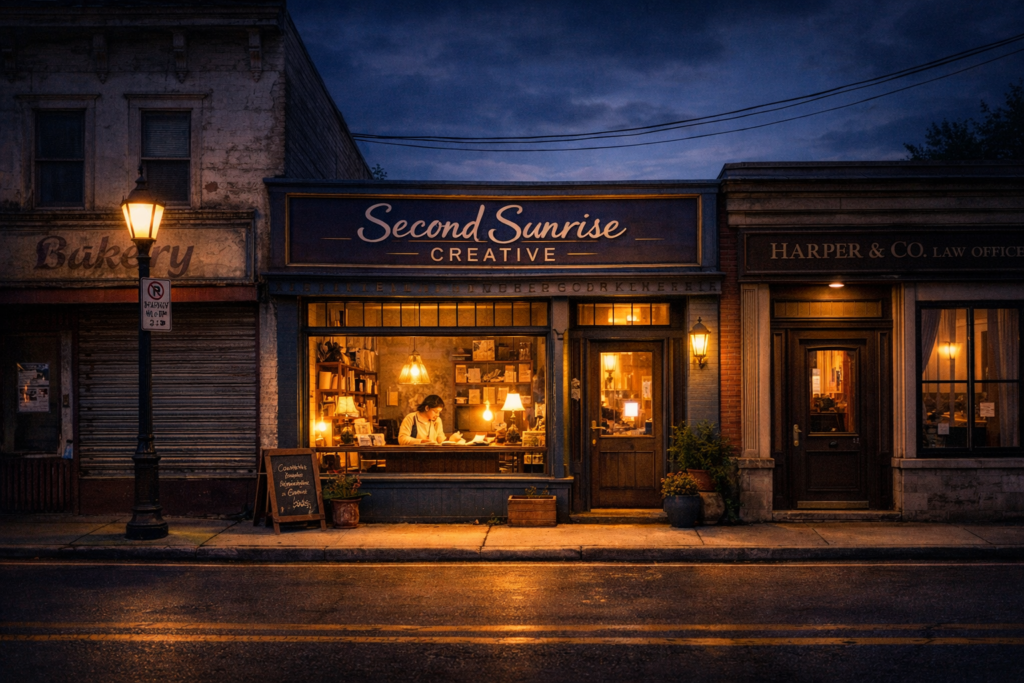
The Light in the Last Window
Fictional Short Story by Deb Ammerman
Every night at exactly 9:47 p.m., one light stayed on in the row of darkened storefronts along Maple Street.
It belonged to Elena Brooks.
Her shop—Second Sunrise Creative—was small, tucked between a long-closed bakery and a law office that only came alive during tax season. Elena sold handmade journals, custom branding kits, and big ideas scribbled on scrap paper. What she didn’t sell much of lately was certainty.
On this particular night, she stood alone behind the counter, staring at her laptop screen. The numbers weren’t great. Again. She’d followed the advice—social posts, email lists, networking events—but nothing felt like it was moving fast enough.
“Maybe I waited too long,” she whispered to the empty room.
That’s when she noticed the flicker.
The old desk lamp near the front window sputtered, then steadied. Elena laughed softly. Even the lamp’s tired, she thought.
As she reached to turn it off, a folded note slipped from beneath the lamp base. She frowned. She was meticulous. Nothing ended up under that lamp.
The paper was yellowed, the handwriting looping and confident.
“If you’re reading this, you’re still in the game.”
Elena’s heart skipped.
The note continued:
“This place has seen slow days, doubt-filled nights, and moments when quitting felt logical. Every owner who made it through left something behind—not money, not answers… but proof.”
She turned the paper over. There were names. Dates. Businesses she vaguely remembered—some still around, some gone, some transformed into something else entirely.
At the bottom was one final line:
“Progress doesn’t always look like growth. Sometimes it looks like staying.”
Elena sank onto the stool behind the counter.
She thought about the client who emailed her earlier that day—not to buy, but to say, “Your last post helped me rethink my business.” She’d brushed it off as nice but insignificant.
She thought about how much she’d learned this year—about pricing, boundaries, storytelling, patience.
She thought about the fact that despite everything, she still showed up.
The next morning, Elena unlocked the door earlier than usual. She rearranged the front display—not to sell more, but to tell a clearer story. She rewrote her “About” page with honesty instead of polish. She followed up with people she’d been afraid to bother.
The numbers didn’t explode overnight.
But the work felt lighter.
Weeks later, a new business owner walked in and said, “I don’t know why, but this place feels… hopeful.”
Elena smiled and glanced at the lamp in the window—the one that still stayed on a little later than the others.
Some nights, when the street is quiet and doubt creeps back in, she leaves a small folded note beneath the lamp.
Just in case someone else needs it someday.


